
Models don’t inherently know what is important. When we train standard vision encoders (like R3M or MVP) to look at the world, they often cheat. Instead of tracking the robot’s gripper or the coffee cup, they track the shadow moving on the table or the clouds shifting outside the window. They prioritize ease over relevance. The authors propose Manipulation Centric Representations (MCR) to address this. By forcing the vision system to predict the robot's physical actions and align with its proprioception (body awareness), they train the robot to relate what it sees with what it is doing, compelling it to focus exclusively on the gripper and the object in a multi-modal way.
important definitions
(For more context on these terms, visit the Morpheus Robotics Research Glossary)
Behavior Cloning (BC)
The Technical Explanation: The simplest form of Imitation Learning used in robotics. Instead of using complex reward functions (like Reinforcement Learning), BC treats robot control as a standard supervised learning problem. It uses a dataset of expert demonstrations (human pilots) and trains a neural network to simply mimic the expert's actions for each video frame. It learns to directly map what it sees to what it does, assuming the expert is always right. Its weakness is an inability to adapt: if the environment changes or the robot's grip slips, it will simply follow its memorized path, even if the outcome is unacceptable.
The Analogy: Imagine an artist trying to learn to draw a masterpiece by placing tracing paper over it and copying every line exactly. As long as the paper stays perfectly still, the copy looks identical to the master's work.
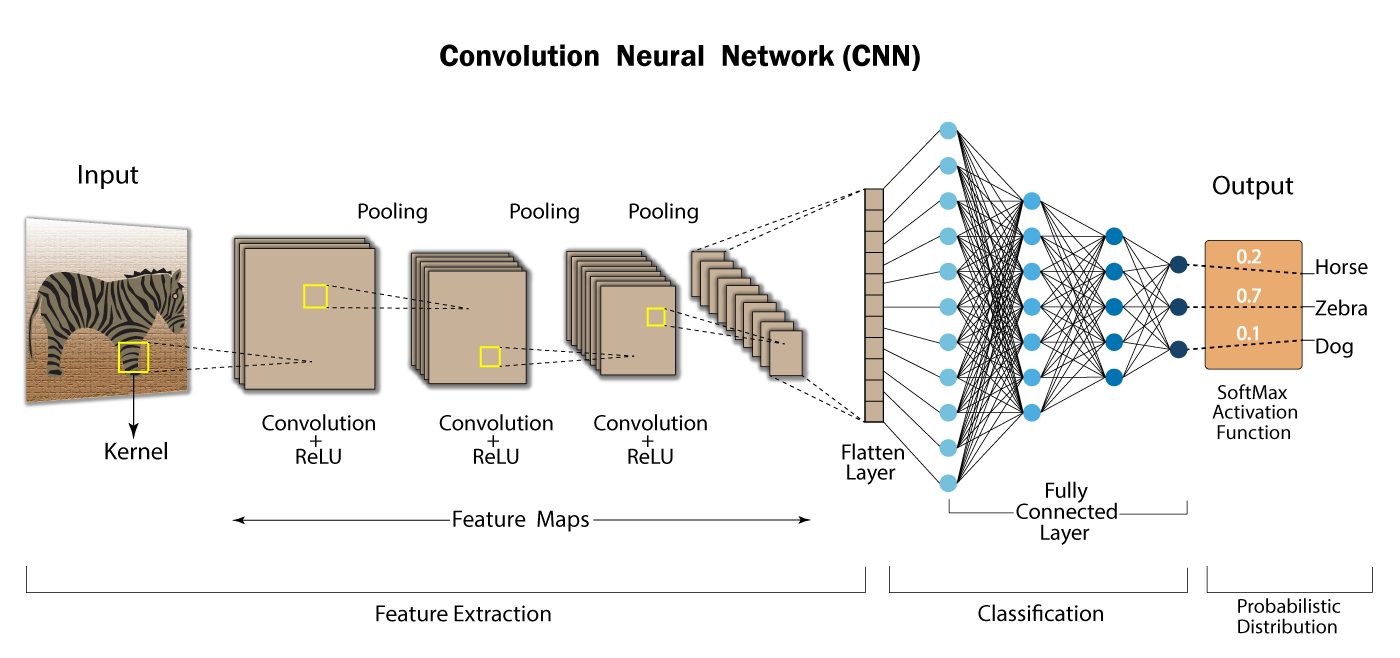
Convolutional Neural Network (CNN)
The Technical Explanation: A classic deep learning architecture (like the ResNet-50 used in this paper) that processes images using a sliding window filter. It exhibits a strong inductive bias toward locality, meaning it naturally assumes that pixels adjacent to one another are related. This makes it highly data-efficient at learning edges, textures, and boundaries (crucial for grasping), but it struggles to capture long-range relationships (e.g., knowing that the switch on the wall controls the light on the ceiling) without being very deep.
The Analogy: The CNN is an assembly line inspector. Imagine an inspector looking at a car on an assembly line through a small magnifying glass. They scan the car inch-by-inch. They are excellent at spotting a scratch on the paint or a loose screw (local details), but because they never see the whole car at once, they might struggle to determine whether the front bumper matches the rear bumper (global context).
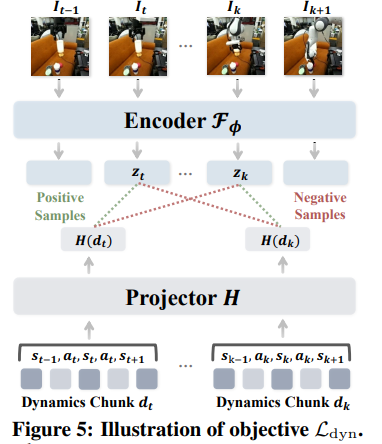
Dynamics Alignment
The Technical Explanation: A cross-modal contrastive learning objective. It effectively forces the visual model to feel what the robot is doing, not just see it. It is a relevance filter. It does so by comparing the vision and robot state between two chunks of time, then forcing the model to disregard all of the irrelevant data between those two chunks (such as lighting changes, camera flickers, and background motion) and retain the important information such as the movement of the arm and the object being manipulated.
The Analogy: A good analogy is lip-reading to listen in a noisy bar. As the music gets louder, you can't rely on hearing alone. You start watching the person's lips (vision) while listening to their voice (proprioception). If you hear a shout but the lips don't move, you ignore it. You only process the words where the lip movement and the sound match. This filters out the background chaos.
Gradient-weighted Class Activation Mapping (Grad-CAM)
The Technical Explanation: A debugging and visualization technique. It effectively asks: Which pixels in this image contributed the most math to the final score?
CNN: For CNNs such as MCR and R3M, this works by backpropagating the gradients of the final decision (e.g., picking up a cup) to the final image-processing layer. If a specific patch (e.g., the robot gripper) is crucial for identifying an action, the gradients flowing back to that spatial token will be high.
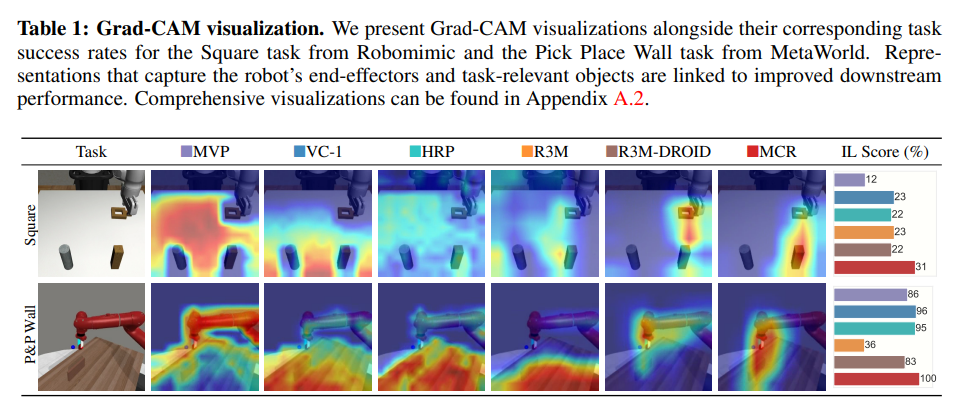
ViT: For ViTs such as MVP, VC-1, and HRP, the final image-processing layer contains no spatial information. In many ViT implementations, the block structure is Input -> Norm -> Attention -> ... The layer norm contains the spatial information before it is mixed in the attention layer, where ViTs capture patch relationships. The paper’s authors used the gradients of the normalization layer to identify which patches contribute to the decision.
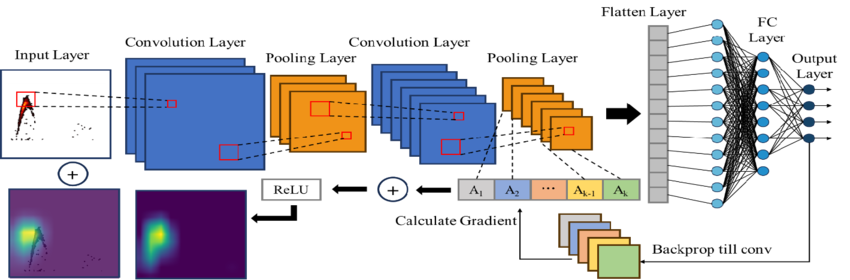
The Analogy: Think of the famous psychology studies on how humans recognize faces. When you look at a person to identify them, your eyes don't scan their whole head evenly. They immediately focus on three areas: the Eyes, Nose, and Mouth. If we tracked your gaze, those three spots would glow Red (Hot) because they contain the critical information. The ears, hair, and wall behind them would be Blue (Cold) because you ignored them. Grad-CAM is this heatmap for the AI. It shows where the model actually looked to recognize you. In the context of this paper, looking at your eyes, nose, and mouth is the equivalent of looking at the gripper and object, not the table or background.
Inverse Dynamics (Action Prediction)
The Technical Explanation: A self-supervised training objective where the model is shown two sequential frames and must predict the specific motor command (action vector) that bridged the gap. This is the primary driver of manipulation centricity because the only way to mathematically solve this problem is to focus on the moving parts (gripper/object) and ignore the static background.
The Analogy: Sherlock Holmes walks into a room (Frame B) that looks different from how it did 5 minutes ago (Frame A). A vase is now broken on the floor. Holmes must deduce exactly what action happened. To do this, he ignores the wall color and the carpet (which didn't change) and focuses entirely on the boot prints and the shards of glass.
Manipulation Centricity
The Technical Explanation: The core metric of the MCR paper. It quantifies the quality of a vision encoder’s attention. It is computed as the intersection between the model's attention heatmap (from Grad-CAM) and the ground-truth object location (from SAM 2).
The Analogy: If the robot task is an archery competition, the object the robot needs to grab is the bullseye, and the pixels the robot is examining are the arrows. Manipulation centricity would be the score of how many arrows hit the bullseye. High centricity is a lot of overlap between the target and the arrows. Low centricity would have arrows scattered around the target, on the wall, and lying on the floor.
Multi-Layer Perceptron (MLP)
The Technical Explanation: A simple, shallow feed-forward neural network consisting of dense layers of neurons. In this context, it is used in two distinct instances. Once, as the policy head, used in pre-training to learn action alignment; and again, as a fresh model, used in behavior cloning of tasks (both simulation and real-world) to control the robot's actions and evaluate the performance of each vision encoder. It is deliberately kept simple (typically 3 layers) so that it cannot perform complex image processing on its own; it must rely entirely on the vision encoder to produce a clear and well-grouped output. It maps the abstract concepts from the vision encoder to concrete coordinate values (x, y, z). The MLP is that fast, reactive layer that turns understanding into movement.
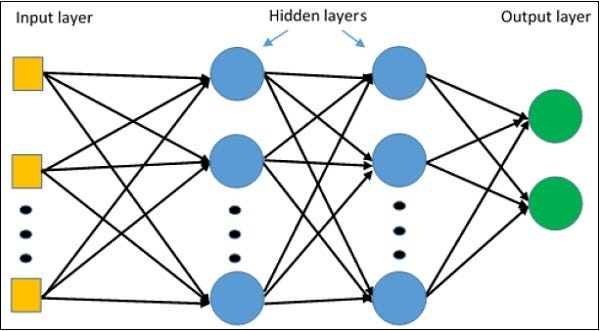
The Analogy: The simple MLP acts as the robot’s nervous system. It relies on the information given to it by the eyes (vision encoder) and motor control (proprioception) to react to danger, such as seeing a bear in the woods. Your spinal cord (The MLP) doesn't think about why it's dangerous; it just receives the danger signal and immediately fires the muscle command to run away.
SAM 2 (Segment Anything Model 2)
The Technical Explanation: A foundation model from Meta designed to extract any object from a video. It uses a memory bank to track an object’s visual features frame by frame, handling occlusions (when the object is hidden) and rotation. In this paper, it provides the ground truth, which the researchers use to track all of the relevant objects in an episode.
The Analogy: SAM 2 tracks objects in a video like an Air Tag tracks objects on a map. No matter where they move, how fast they go, or if the lights go out, you know their exact location.
Vision Transformer (ViT)
The Technical Explanation: The modern SOTA (state of the art) architecture for image processing that treats images as a sequence of "tokens" (patches), similar to how LLMs treat words. It has a global receptive field from the very first layer, meaning every pixel can talk to every other pixel instantly via Self-Attention. It can group pixels on the screen by semantics, making it highly effective for understanding what it is looking at. However, it lacks the inductive bias of CNNs, meaning it requires millions of examples to learn that adjacent pixels form an edge.
The Analogy: The vision transformer is like the master architect for a building. A bricklayer (CNN) inspects a wall one brick at a time with a magnifying glass. They know if the mortar is cracked (local detail), but they might not realize the wall is in the wrong room. Meanwhile, the Architect (ViT) considers the entire blueprint simultaneously. They immediately understand the house's flow, the relationship between the kitchen and the living room (Global Context), and the structural integrity. However, because they are looking at the big picture, they might miss a tiny scratch on a single brick.
the paper's hypothesis
The authors challenge the bigger is better narrative of passive internet video training. Their core arguments are:
- Focus equals Performance: Visual encoders that focus specifically on the gripper and object interaction will outperform generic encoders that do not, even if trained on less data.
- We need a good KPI: Manipulation centricity, the percentage of overlap between where the model is focusing and the location of critical items, such as grippers and active objects, in a scene, is a strong indicator of downstream performance.
- Smaller multimodal datasets outperform large single-modal datasets: Critical items such as dynamic labels (proprioception and action) are key for training a robot how to focus. This is one reason high-quality robot datasets can outperform large-scale human datasets.
the paper's approach
The methodology comprises three components: the KPI, the training recipe, and the evaluation process. Each is important in understanding their takeaways.
Manipulation centricity, the key performance indicator (KPI): The paper first establishes a method to test its hypothesis that vision encoders that focus on action-relevant objects and robots will perform better at object manipulation.
The first step in determining whether the visual encoder is looking at the correct parts of the image is to establish the ground truth of where it should be looking. In this case, they should be fixating on the gripper and the objects they are interacting. Then a score of manipulation centricity can be measured to see how much overlap is between their gaze and the ground truth.
- SAM 2 (The Truth): They used the SAM2 to create accurate masks of the robot gripper and the manipulated object. It tracks pixels based on initial prompts, without knowing what the object is or how it’s used, it provides an unbiased, pixel-perfect reference of where the object actually was.
- Grad-CAM (The Heatmap): They use Grad-CAM to understand what the visual encoder is looking at to make its decisions. CNNs like MCR and R3M.
- Manipulation Centricity: The measure of how much overlap is between these two maps. It is a metric that helps assess what each encoder focuses on in each frame.
The Training Recipe (The Three Pillars of MCR): They encourage the model to focus on relevant information by filtering out jitter and background noise and by promoting causal learning.
- Dynamics Alignment (L_dyn):
- The Mechanism: They contrast the difference between two chunks from the episode of the same length at different points in time. The differences between these chunks are related to changes in the robot arm, gripper, and active object position. A loss function uses these chunks to pull together the visual embedding (what it sees) closer to the proprioceptive embedding (what it feels).
- The Effect: This acts as a filter. If the lights flicker, the visual embedding changes, but the proprioception does not. The loss function forces the visual model to ignore the flicker (background noise) and focus only on the arm, because that is the only thing correlating with the joint angles.
- Action Prediction / Inverse Dynamics (L_act):
- The Mechanism: The model is given Frame t and Frame (t+1) and asked: What action caused this change? The encoder and training MLP together learn how to predict the robot's actions required to move from one frame to the next. After training is complete, the MLP is pruned and discarded, leaving the focused visual encoder, MCR.
- The Effect: This is the detective logic. MCR learned to focus on the scene's details to determine the next course of action. You cannot predict a hand movement by looking at the wall behind it. To minimize error, the model is mathematically forced to ignore the static background and focus exclusively on the moving parts (gripper and object).
- Time Contrastive Learning (L_tcl):
-
The Mechanism: This is borrowed from R3M. Three frames in time are compared.
- The reference frame, let's say it shows a robot hand halfway towards the cup.
- The positive frame, just a fraction of a second later, shows the hand a little closer to the cup.
- The negative frame, a point far away in time, such as 10 seconds later, when the hand has picked up and moved the cup.
The loss function pulls the anchor and positive frames together in the latent space, since the images are so similar. The anchor and negative frame are pushed apart by the large change in state.
-
The Effect: It ensures that the model treats frames from the same point in time as related. Even if there is camera jitter or light flickering. It also learns a sense of progress, since each frame is linked to similar frames that have made incremental progress and is separated from frames that have a distinctly different state.
-
Building the Robot Brain
The authors used a ResNet-50 architecture trained on Droid, a high-quality robot dataset, and pruned it to include only episodes longer than 40 frames and containing an action label.
According to academic standards, evaluation is performed using a frozen encoder (e.g., the encoder in this paper, R3M, MVP) paired with a lightweight MLP. They do not fine-tune the vision model during downstream task trials, and they use a fresh MLP during the evaluation phase to prevent policy transfer from the visual encoder's pretraining.
- The Vision Encoder (Frozen)
- Input: 224x224 or 196x196 RGB Image.
- Model: The pre-trained MCR ResNet50 (weights are frozen).
- Output: A 2048-dimensional feature vector.
- The Fusion Layer
- Input: They take the 2048-dimensional visual vector and concatenate it with the proprioceptive vector.
- Proprioception vector composition: For a standard 7-DoF arm (like the Franka Panda used in DROID), this typically includes:
- Joint Positions: 7 dimensions.
- Joint Velocities: 7 dimensions.
- Gripper State: 2 dimensions (position + velocity).
- Total Proprioception: 16 dimensions. Humanoids would require a vector of dimensions between 60 and 165, depending on the model and gripper selection.
- Output: A single combined state vector of 2064 dimensions (2048 vision + 16 proprioception).
- The MLP Policy Network
- The MLP is trained via behavior cloning (BC) to conduct the evaluation task. It is the only part of the model that learns in this stage, since the encoder is frozen.
- Model: The real-world model is a simple 3-layer MLP (Multi-Layer Perceptron) with ReLu activations based on the V-D4RL codebase. All simulations use a 3-layer MLP, except for Robomimic, which uses one that is two-layer.
- Output: The robot actions can be represented as a 7-dimensional vector, such as (x, y, z, roll, pitch, yaw, gripper).
Testing and Evaluation
The visual encoders are compared both in simulation and in the real world. All tasks used for evaluation rely on behavior cloning to be learned by the fresh encoder and MLP pair.
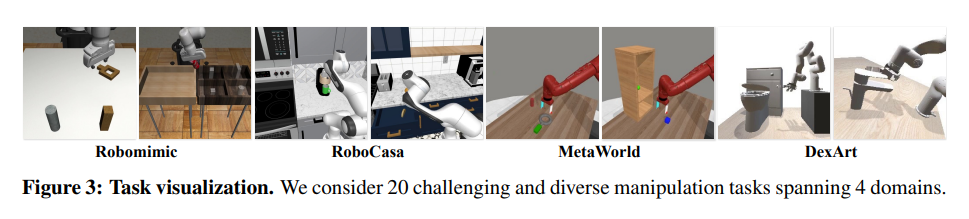
The paper discussed the simulators: MetaWorld, DexArt, RoboMimic, and RoboCasa. Including tasks such as pulling and pushing a box, opening a laptop, and picking up objects. They add a full list in Appendix A, including a full table of results.
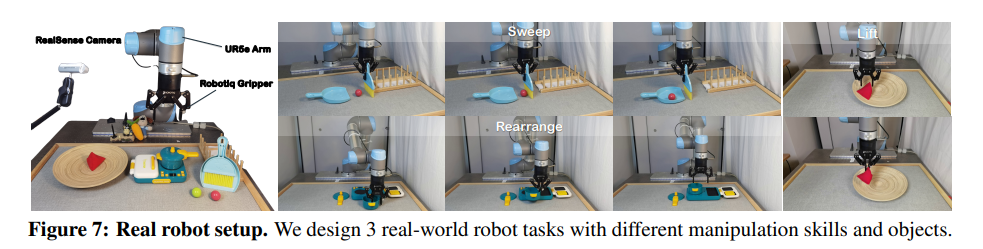
They also set up a real-world comparison using a UR5e arm, RobotIq 2F-85 gripper, and RealSense D435i camera. Which is notably a different embodiment and camera from the Franka Panda arm and Zed 2 camera used in the DROID database. They capture the training dataset using a human controller and keyboard. All trials begin with the same set of startup conditions. The tests are lifting, sweeping, and rearranging.
findings and conclusions
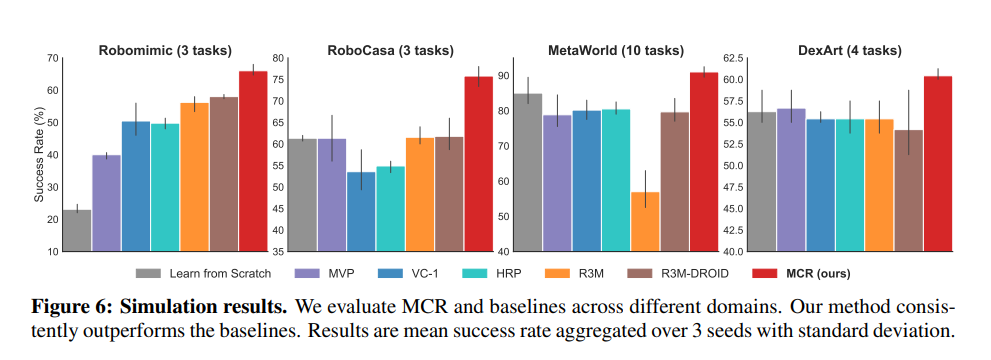
The results provide strong validation for the value of interaction and proprioception data. The test results indicated that MCR beats R3M, even when trained on the same data, such as R3M-DROID. This shows that additional performance of the vision encoder can be gained with the addition of proprioceptive data. This is in addition to the temporal focusing applied in both R3M and MCR, as well as the performance of ResNet-50 for feature detection.
Findings and Conclusions
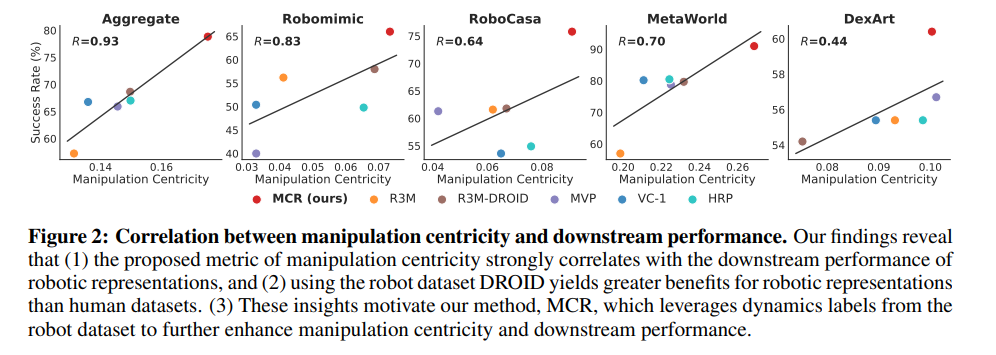
The metric of manipulation centricity shows promise as a KPI. Like many KPIs, it is more directionally correct than absolute precision. The paper found a 0.93 correlation between manipulation centricity and the success rate on the tasks they conducted. This somewhat states the obvious: if the robot doesn’t look at the gripper and the task at hand, then it fails.
Ablation Studies
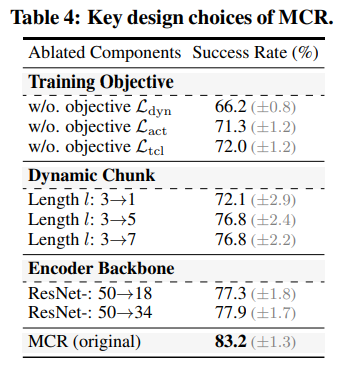
In ablation studies (evaluating performance when a specific feature is removed), the paper found that dynamic alignment was the largest contributor to improved performance; however, all three pillars of MCR, dynamic alignment, action alignment, and temporal contrast, appeared to be part of its success. They also found that increasing the dynamic chunk size used for dynamic alignment saturated in performance at approximately 5 frames per chunk. And they found that of the three ResNets they compared as the backbone of MCR< ResNet-50 was the most performant.
Dataset Scaling
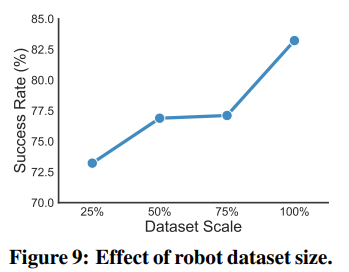
The paper shows that a smaller version of the DROID dataset would have performed worse. The curve they show does not appear to level off, indicating that they are not near the ResNet-50 saturation point (~30 million unique frames). This further supports the need for more high-quality data.
Not all data is made equal. One of the more interesting findings here is that a small, highly multi-modal dataset can outperform a larger dataset. Models trained on the DROID dataset (350hrs), such as MCR and R3M-DROID, outperformed models trained on the 10x larger EGO4D dataset. The paper claims this is because the DROID dataset was generated by a robot rather than a human. I propose an alternative hypothesis, which I will present below.
reviewer's opinions & analysis
Proprioception and Dynamic Labels help focus on what matters This paper’s use of proprioception to identify important regions in an image is quite insightful. This provides a robot alternative to the discussion we had last week reviewing HRP. Instead of detecting bounding boxes for the object, hand pose, and contact estimates, they propose the use of robot joint angles and gripper positions in the Cartesian plane. More interestingly, what they chose to do with this data. There is real promise in using dynamics alignment to filter out irrelevant background noise based on the gripper's known position. This addresses the weakness of temporal contrast, where moving objects in the background can also draw the encoder's attention. This is a brilliant, elegant way to filter out visual garbage without needing expensive human labeling.
Robot Data vs. Human Data The paper posits that Robot Data > Human Data because robot data includes proprioceptive information (joint angles), which enables action and dynamics alignment, enabling MCR. I agree with the perception that true multimodal data is far more valuable than monomodal data. However, human data need not be monomodal. Much of the technology needed to track human motion and relative position exists today; we have been using motion capture to create movies for years, and SLAM to determine camera position, outside a robot, for the last decade. Combining these technologies to enable mass, truly multimodal human data collection is part of Morpheus’ mission.
We know that multi-modal human data is effective for training robot policies. Upcoming literature reviews will dive into some of the evidence we have amassed. Human data are far cheaper and faster to collect, even when collected multimodally.
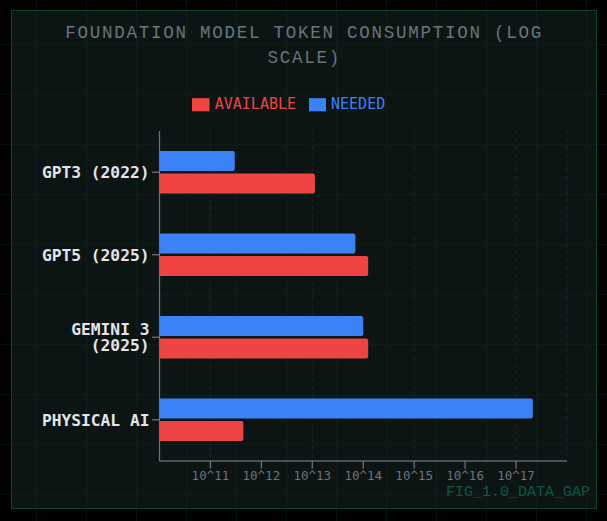
I would, however, be very interested in seeing future research that applies some of the alignment techniques used in MCR to be used with high-quality multimodal human data, which I believe are necessary to collect the millions of hours needed to fill the general robotics data gap.
Concerns over the use of a ResNet backbone. While the method is common in research, and there are a lot more ResNet-50 research papers to compare, like R3M, by 2023 it was widely accepted that ViTs are the future. They understand the image at a higher level and more natively integrate with the LLM as the knowledge center.
The real question is how we can mitigate their weaknesses relative to the CNN, such as speed, training data efficiency, and lower detail orientation. I think papers that address these challenges, such as MVP and HRP, advance the field more and strongly encourage other researchers to focus on this area. ViT has a much higher capacity to learn the big picture, which is far more important for robots in the wild.
In research settings, with simple tasks and minimal data, CNN-based architectures have a strong advantage. They are quick to learn, but eventually they saturate and will fail to learn more, which is a critical failure out in the wild. Think of a neural network's capacity as a vessel for liquid (data).
- ResNet-50 (CNN) is a coffee mug. It is great at holding specific things (local features), but it overflows if you pour too much data into it.
- ViT-Large is a 5-gallon bucket. It requires a massive amount of liquid to fill it up, but once full, it holds significantly more context.
The authors filled the mug with the DROID dataset. It worked great because the dataset size (~20M frames) matched the capacity of the mug. However, as we move toward general-purpose robots, this architecture will cap out. A more promising architecture is ViT + Feature Pyramids; the bucket holds the massive scale of world knowledge, but tools like MCR’s logic force it to attend to detail.
The Morpheus Solution: At Morpheus, we are taking this a step further. We don't just want to estimate where the hand is from video; we want to measure it. By building tools to collect human data with high-precision wrist tracking and tactile sensing, we are creating a dataset that has the scale of human activity but the fidelity of robot logs. MCR proves that aligning vision with body-state is the key to focus. We think this is important across the visual, spatial, and tactile domains. You can have perfect manipulation centricity, with your robot staring directly at the wine glass with 100% attention, and it will still crush the glass if it doesn't know how hard it is squeezing.